
High-Performance Fasteners for Marine, Petrochemical & Power
High-Performance Fasteners for Marine, Petrochemical & Power
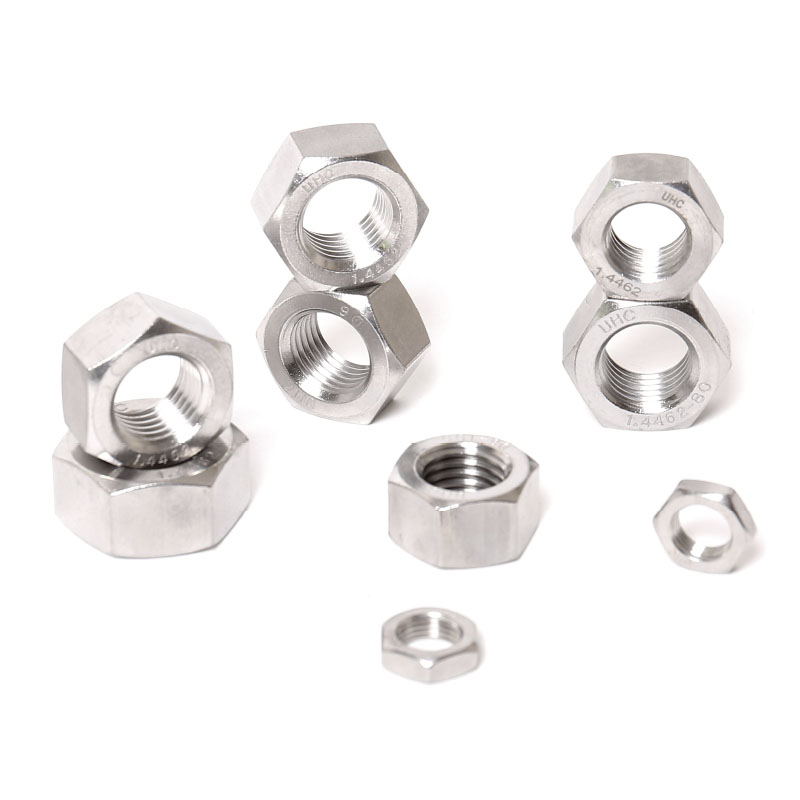
Stainless steel nut range: hex, heavy, coupling, flange, nylon-insert, castle and self-locking types from M2 to M64.
Short answer: specifying high-performance fasteners for marine, petrochemical and power generation projects follows a fixed order. Define the joint and its working conditions, choose the component form, choose the alloy family, choose the surface treatment, then fix the thread tolerance class and strength grade and cite the standard that verifies all of it. A fastener can pass dimensional inspection and still be the wrong choice for the joint when one of those steps is skipped or left to the supplier.
The reference ranges in this guide come from UHC Group (Jiaxing Union Hardware Co., Ltd.), a stainless steel products supplier founded in 2017 that operates five production bases covering washers, bolts and nuts, screws, studs and rivets, and hardware. Its listed product range includes 304/316 stainless steel fasteners, high-temperature alloys such as Inconel and Hastelloy, titanium and aluminium alloy fasteners, and custom OEM/ODM hardware, with about 80% of output exported and main markets in the EU, Korea and Japan.
Why one fastener specification cannot serve three environments
Marine and offshore work is governed by chloride exposure. Seawater, salt spray and splash-zone wetting act on the fastener surface continuously, and the assembly usually sits under permanent mechanical load. ISO 3506-1 is the reference standard for the mechanical properties of corrosion-resistant stainless steel bolts, screws and studs, and UHC's material guidance points marine and coastal salt-spray conditions toward 316L or duplex steel rather than the general-purpose 304 grade.
Petrochemical plants add chemistry to the same problem. Acid and alkali corrosive environments, high temperature and pressure-retaining duty can occur in one unit, and fasteners for pressure equipment in the EU must comply with the Pressure Equipment Directive 2014/68/EU. Flanged joints are also opened for maintenance, so threads and coatings have to tolerate repeated assembly rather than a single installation.
Power generation is dominated by temperature and load history. High-temperature sections, continuous mechanical load and long intervals between outages mean a fastener must hold preload for years, which is the reason UHC's range includes high-temperature alloy fasteners in Inconel and Hastelloy alongside A2 and A4 stainless grades.
The practical consequence is that a component correct in one environment is not automatically correct in another. The alloy that answers a salt-spray problem may be the wrong specification for a high-temperature flange, and a coating added to protect one assembly may be unnecessary on a fully stainless joint that is already protected by its own alloy.
What the industrial fastener market says about specification pressure
These three sectors sit inside a large category. Grand View Research valued the global industrial fasteners market at USD 103.9 billion in 2025 and projected USD 153.7 billion by 2033, with Asia Pacific holding a 45.1% revenue share in 2025. Within the total, metal fasteners accounted for 91.0% of the market in 2025, and externally threaded products such as bolts and screws accounted for 48.1% of revenue.
Research firms publish different totals depending on which segments they include, so these figures indicate scale rather than a single agreed number. What matters for a specification is the mix: most of the value sits in threaded components, which is exactly where thread tolerance class, strength grade and alloy choice concentrate. For buyers in the EU, Korea and Japan, three of UHC Group's main markets, the practical question is rarely whether high-performance fasteners exist. It is whether a specific component in a specific alloy can be documented against the standard the project cites.
Step 1: Match the component form to the joint, not the catalogue
The component form decides how a joint can be assembled, tightened and later dismantled. UHC's data lists six families, each with its own size range, grades and, where applicable, thread class.
| Component form | Listed size range | Listed strength grades | Listed thread class | Typical role in these projects |
|---|---|---|---|---|
| Bolt (hex, flange, heavy, T-bolt, U-bolt, fit, square, anchor, foundation) | M2–M160; 6–300 mm effective length | A2-70, A2-80, A4-70, A4-80, D6-80, D6-100 | 6g/2A | Structural and flanged joints, supports, skids, anchorages |
| Nut (hex, heavy, coupling, weld, flange, nylon, jam, castle, slot, self-locking) | M2–M64 | A2-70, A2-80, A4-70, A4-80, D6-80, D6-100 | 6H/2B/3B | Mating element; locking styles where vibration is present |
| Threaded rod / stud (full thread rod, double-end stud) | M5–M160; length up to 5000 mm | A2-50, A2-70, A4-50, A4-70, D6-80, D6-70 | 6g/2A | Flanged joints with one-side access, long tie rods |
| Screw (tapping, marine, self-drilling, set, chipboard, socket cap, drywall) | M2–M8; 6–100 mm | A2-70, A2-50, A4-70, A4-50 | — | Covers, brackets, instrumentation, secondary assemblies |
| Rivet nut (open type, close-end type) | M3–M6.4 | — | — | Threaded connection in thin sheet with one-side access |
| Washer (flat, heavy, toothed lock, serrated, wave) | M2.5–M45 | — | — | Load distribution, surface protection, locking and spring functions |
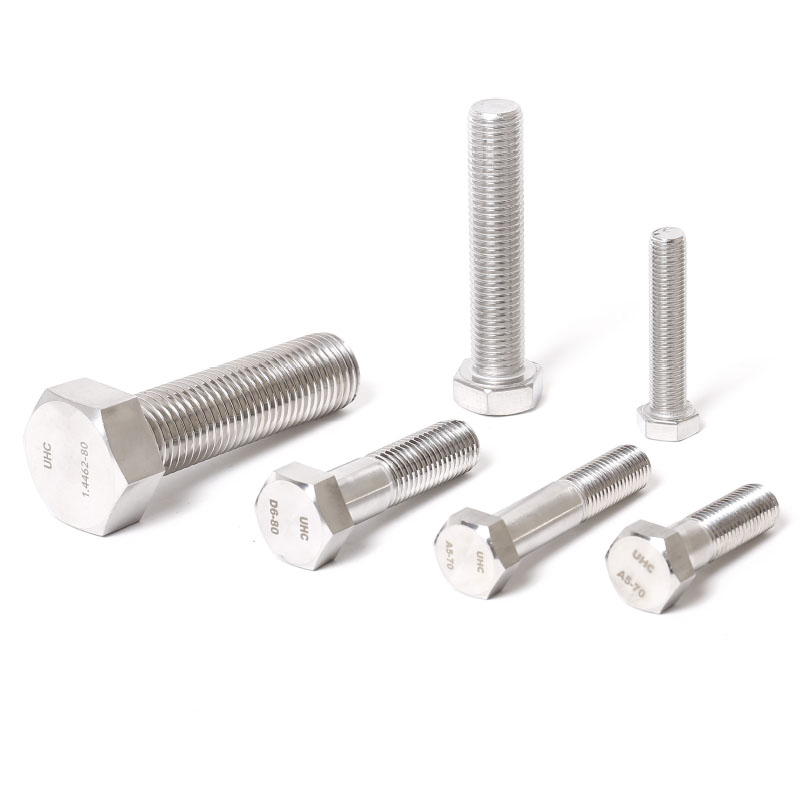
Bolts carry the widest listed range: M2 to M160 and 6 mm to 300 mm effective length.
Bolts are the broadest family in the data: hex, flange, heavy, T-bolt, U-bolt, fit, square, anchor and foundation types from M2 to M160 and 6 mm to 300 mm effective length. For a flanged joint in a petrochemical unit, the choice between a bolt and a stud is usually an access question. A through-bolt needs clearance on both faces, while a double-end stud or full-thread rod allows the joint to be broken and remade from one side, which is why the stud range runs to M160 and 5000 mm.
Nuts are the mating half and the place where locking behaviour is decided. The listed types include hex, heavy, coupling, weld, flange, nylon-insert, jam, castle, slot and self-locking nuts from M2 to M64. Where high vibration is part of the working condition, a self-locking nut or a castle nut with a split pin gives a mechanical answer instead of relying on preload alone.
Screws cover the smaller end: tapping, marine, self-drilling, set, chipboard, socket cap and drywall types from M2 to M8 and 6 mm to 100 mm, typically used for covers, brackets, instrumentation and secondary assemblies. Their listed alloy range is narrower, at 304, 316 and UNS S32205, so a nickel-based alloy requirement moves the design toward a bolt, stud, nut or washer rather than a screw.
Rivet nuts in open and close-end form, M3 to M6.4, in 304, 316, 6061 and 7075, create a usable thread in thin sheet where only one side can be reached. Washers from M2.5 to M45 in flat, heavy, toothed lock, serrated and wave forms spread load under high tensile joints, protect the mating surface, and in the toothed and wave versions add a locking or spring function.
Step 2: Map the alloy family to the environment
Alloy choice is where the three environments separate most sharply. UHC's bolt, nut, stud and washer data share one material set that runs from austenitic stainless through duplex and super duplex to nickel-based high-temperature alloys. Screws are listed in 304, 316 and UNS S32205 only, and rivets in 304, 316, 6061 and 7075.
| Family | Designations in the listed range | Where it fits | Check before ordering |
|---|---|---|---|
| Austenitic stainless (A2/A4) | 304, 316, 1.4571/316Ti | General indoor and moderate conditions; 316 where chlorides are moderate | UHC's guidance points marine salt-spray duty to 316L or duplex rather than 304 |
| Higher-alloyed austenitic | 1.4539/904L, 1.4529/UNS N08926 | More aggressive chemistry where duplex is not the specified route | Confirm the grade is available in the component form required |
| Duplex and super duplex | UNS S32205/1.4462, UNS S32750/1.4410 (2507) | Marine and offshore, high-chloride duty; higher strength classes D6-80 and D6-100 are listed | Match the grade to the strength class and thread class on the drawing |
| Nickel-based high-temperature | 1.4980/A286 Alloy 660, 2.4952, 2.4668/Alloy 718, Alloy 80A | High-temperature power generation and process joints | Long studs: confirm supply in the required length up to 5000 mm |
| Martensitic stainless | 1.4006/S41000 | Where a 410-type stainless is specified | Not a substitute for the austenitic corrosion grades |
| Aluminium and titanium | 6061, 7075 (rivets); titanium and aluminium alloy fasteners in the company range | Weight-sensitive assemblies and isolated connections | Manage contact with steel to avoid a galvanic couple |
The mapping rule that matters most is the one UHC states directly. General indoor conditions favour 304/316 stainless; high-corrosion, offshore and marine conditions favour 316L, duplex steel or a high-temperature alloy; and high-strength mechanical load scenarios call for alloy steel fasteners, with material selection adaptable to the project's working conditions. That hierarchy is more useful than a single recommended grade, because it starts from the working condition rather than the catalogue page.
Two boundaries belong in the specification. First, a higher-alloyed grade is justified by a temperature or chemistry reason, not treated as a default upgrade, because it changes the purchasing and lead-time profile of the order. Second, alloy and component choice interact: with screws listed only in 304, 316 and UNS S32205, a high-temperature joint cannot be specified as a screw assembly in a nickel-based grade from the listed range.
Step 3: Choose the surface treatment the environment actually attacks
Surface treatment is listed for bolts, nuts, studs and screws in four options: natural finish, passivation, Dacromet coating and adhesive pre-coating. The right choice follows the environment and the assembly method rather than the finish name alone.
- Natural finish leaves the alloy surface as produced. Where the alloy itself carries the corrosion duty, a 316L or duplex component in a marine joint keeps the specification simple and avoids adding a coating layer that later has to be inspected and maintained.
- Passivation is the treatment most closely tied to stainless performance in chloride service: it removes surface contamination and free iron and supports the passive oxide layer, which is why it is a common requirement on stainless components for coastal and offshore work.
- Dacromet coating is listed as an anti-corrosion finish across the four component families, and UHC presents its surface-treatment range as a route to anti-corrosion performance. When a drawing calls for a coated fastener, name the coating together with its thickness and verification requirement, otherwise two suppliers can both quote the same finish name and deliver different assemblies.
- Adhesive pre-coating applies a locking and sealing adhesive to the thread before delivery. It is a process decision as much as a corrosion decision, because it moves thread-locking from the assembly line to the fastener — relevant where joints are made in the field, in confined spaces, or under the high-vibration conditions listed for these applications.
Step 4: Fix thread tolerance class and strength grade before quotation
Thread class and strength grade turn a material choice into a purchasable part. On the external thread, UHC lists 6g/2A precision threads for bolts and threaded rods/studs. On the internal thread, nuts are listed with 6H/2B/3B. These are not decorative markings: the tolerance class sets the clearance between mating threads, which affects assembly force, galling risk and how consistently a joint reaches its target preload. A purchase order that names an alloy but omits the thread class leaves that variable to the supplier.
Strength grades follow the component. Bolts and nuts list A2-70, A2-80, A4-70, A4-80, D6-80 and D6-100. Studs list A2-50, A2-70, A4-50, A4-70, D6-80 and D6-70. Screws list A2-70, A2-50, A4-70 and A4-50. The A2 or A4 designation identifies the steel family and the number identifies the property class; ISO 3506-1 specifies the mechanical properties of corrosion-resistant stainless steel bolts, screws and studs, so a property class written on a drawing should be traceable to that document.
One caution applies in all three environments. A higher property class is a strength statement, not a corrosion statement, and the cold working that raises strength is a separate decision from the alloy that resists the environment. Specify both, and keep them separate on the drawing so a substitution in one does not silently change the other.
Step 5: Use standards as checkpoints, not decoration
Standards are what allow two quotations to be compared. UHC's data lists execution to ISO, DIN, ASTM, ASME, ANSI and JIS across bolts, nuts, studs, washers and screws, while the rivet and rivet nut data lists ISO, DIN, ASME, ANSI and JIS. That coverage matters because the three environments rarely use one document set: a German or Italian package may cite DIN or EN documents, a US package ASTM or ASME, a Japanese package JIS, and an international package a mixture.
Four references are worth carrying into any specification review:
- ISO 3506-1:2020 — mechanical properties of corrosion-resistant stainless steel bolts, screws and studs.
- EN 14399 series — high-strength structural bolting assemblies for preloading, where the joint is a preloaded steel structure.
- PED 2014/68/EU — the Pressure Equipment Directive; fasteners for pressure equipment in the EU must comply with it.
- ISO/IEC 17025 — the benchmark for testing and calibration laboratory competence, which is what a buyer is really assessing when a supplier presents test reports.
UHC Group holds ISO 9001, ISO 14001, ISO 45001 and PED certification, and operates an independent laboratory equipped for dimensional and mechanical performance testing. For a buyer, that combination is the difference between a certificate of conformity and a test result that can be traced back to a batch.
The six-line specification checklist
Before an RFQ leaves the project team, the specification should answer six questions in writing:
- Working condition: temperature range, medium (seawater, acid or alkali, process fluid), load type, and whether the joint is permanent or opened for maintenance.
- Component form: bolt, stud, screw, rivet nut, or nut-and-washer combination, with the assembly and access method stated.
- Alloy family and exact designation — for example UNS S32205, 1.4980 or 316Ti — not simply "stainless steel".
- Surface treatment: natural finish, passivation, Dacromet coating or adhesive pre-coating, with the verification requirement.
- Thread tolerance class and strength grade for every threaded component in the assembly.
- Standard and documentation: the standard the part is executed to, the property class, the material certificate and the traceability requirement.
Where the same decision logic pays off: three project settings
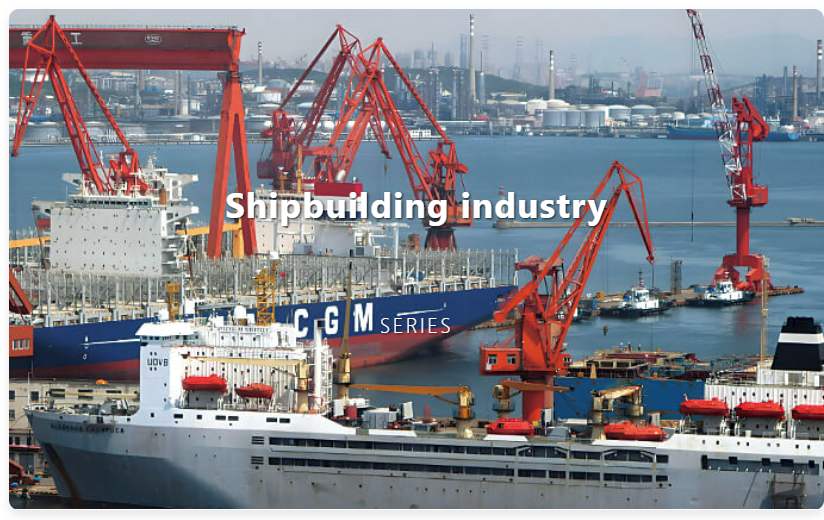
Marine and offshore structures combine permanent joints with chloride exposure and scheduled inspection access.
Marine and offshore
A marine or offshore package usually combines permanent structure with joints that must be opened for inspection. In that setting the specification tends to settle on 316L or duplex steel for wetted and splash-zone components, passivation as the finish, studs for flanged connections, and washers to spread load and separate contact surfaces. Vibration is present but secondary to chloride attack, so the sealing and locking function of adhesive pre-coating is often more relevant there than its corrosion role.
Petrochemical
Petrochemical units combine chemistry with pressure. A flanged joint may need a nickel-based stud for temperature, a nut with a 6H/2B/3B internal thread to match it, and a coating decision that survives both the process atmosphere and repeated dismantling. Where the assembly is pressure equipment destined for the EU, PED 2014/68/EU sets the compliance route, and the material certificate becomes part of the handover file rather than a purchasing attachment.
Power generation
Power generation fastening is a preload problem as much as a corrosion problem. High-temperature sections call for the nickel-based grades in the listed range — 1.4980/A286 Alloy 660, 2.4952, 2.4668/Alloy 718 and Alloy 80A — while cooler structures can remain on A2 or A4 stainless. Studs and heavy bolts dominate because the joints are large, permanent and expensive to rework once the plant is in service.
UHC's documented supply record in these sectors covers fastening assembly for marine equipment and power generation facilities, alongside aerospace parts and automotive chassis, at a quantity of 100,000 pieces over a 10-year supply relationship for customers in Germany, Italy, Korea and Japan. The stated result is reduced later maintenance replacement cost and stable project operation, on a stated basis of high tensile and anti-fatigue strength, seawater and acid-base corrosion resistance, high-temperature resistance and compliance with DIN, ISO, JIS, ASME and ASTM standards.
Documentation and traceability for project handover
UHC Group operates five production bases on 80,000 m² with 200 employees, a 25-engineer R&D team and annual output of 25,000 tons of stainless and special materials. Quality control is listed as first article inspection, in-process inspection and pre-shipment inspection, supported by a 3.1 material test certificate, after-sales quality problem handling and batch quality tracing. An ERP system covers the flow from raw material procurement through to finished product delivery.
For a project buyer, those are the inputs to a supplier file: which production base makes the component, which inspection stage releases it, and which document follows the batch to site. They also define what to ask for in the quotation, because a specification that cannot be verified at those three points is only a description.

One of UHC Group's five production bases, where first article, in-process and pre-shipment inspection are applied.
Frequently asked questions
Which documents should a buyer check before releasing a fastener order for a marine or pressure project?
Start with the property class on the drawing and confirm it against ISO 3506-1, which specifies the mechanical properties of corrosion-resistant stainless steel bolts, screws and studs. For pressure equipment in the EU, PED 2014/68/EU sets the compliance requirement, and UHC Group holds PED certification alongside ISO 9001, ISO 14001 and ISO 45001. Then ask for the 3.1 material test certificate, the inspection records from first article, in-process and pre-shipment stages, and the batch tracing reference. Where test reports are presented as evidence, ISO/IEC 17025 is the benchmark for the competence of the laboratory that produced them.
Can one supplier cover bolts, nuts, studs, screws, rivet nuts and washers across these alloys?
UHC Group covers the six component families through five production bases specialising in washers, bolts and nuts, screws, studs and rivets, and hardware. The listed ranges are M2–M160 for bolts, M2–M64 for nuts, M5–M160 and up to 5000 mm for studs and threaded rods, M2–M8 for screws, M3–M6.4 for rivet nuts and M2.5–M45 for washers, executed to ISO, DIN, ASTM, ASME, ANSI and JIS except for rivets, which list ISO, DIN, ASME, ANSI and JIS. Two limits are worth noting at the quotation stage: screws are listed only in 304, 316 and UNS S32205, and nickel-based grades appear in the bolt, nut, stud and washer ranges rather than the screw range.
What commercial minimums should a project plan for?
The listed commercial parameters are a 150 kg minimum order quantity, a 75–90 day lead time and a monthly capacity of 500–1000 tons. Customisation includes head mark and logo, and the production mode covers OEM and ODM. Export markets are listed as the EU, US, Japan, Korea, the Middle East and South America, with the EU, Korea and Japan named as main markets and about 80% of output exported. Alloy, size, thread class and surface treatment are fixed before a lead time is confirmed, because each of them changes the production route.
How can a project team evaluate fasteners before committing to series supply?
The evaluation route runs through documented inspection rather than samples alone. UHC's quality control covers first article inspection, in-process inspection and pre-shipment inspection, with an independent laboratory for dimensional and mechanical performance testing and a 3.1 material test certificate released with the order. For a specific drawing, the practical step is to send the joint conditions, the alloy and the standard to the supplier so the component, finish and thread class are confirmed before the first article is produced.
How is supply continuity and traceability managed over a multi-year project?
Continuity rests on the production footprint and the traceability system. Five production bases on 80,000 m², 200 employees and annual output of 25,000 tons of stainless and special materials give the capacity base, while the ERP system manages the flow from raw material procurement to finished product delivery so each step stays traceable. After-sales support includes batch quality tracing and quality problem handling, which is what makes a 10-year supply relationship auditable rather than anecdotal. Project teams usually settle continuity questions alongside the first drawing review, so sending the working conditions and expected annual volume together is the shortest route to a documented answer.
Conclusion: the environment writes the specification
Marine, petrochemical and power generation projects do not need three different definitions of a high-performance fastener. They need the same definition applied with a different priority: chloride resistance first for offshore work, chemistry and pressure compliance first for petrochemical units, and temperature plus preload retention first for power generation. The sequence that satisfies all three is stable — working condition, component form, alloy family, surface treatment, thread tolerance class and strength grade, then the standard and documentation that prove the choice.
UHC Group's listed ranges support that sequence end to end: bolts to M160, studs to 5000 mm, nuts with 6H/2B/3B threads, washers to M45, rivet nuts to M6.4, screws with adhesive pre-coating, and alloy coverage from 304/316 through duplex and super duplex to nickel-based high-temperature grades, all executed to international standards and backed by PED, ISO 9001, ISO 14001 and ISO 45001 certification. Where a joint condition is already defined, the next step is to check it against those ranges before the drawing is frozen; the UHC Group team can review component, alloy, finish and standard together, and the company brochure summarises the wider product and capability profile.

UHC Group head office, Jiaxing, Zhejiang — the contact point for specification review and project documentation.
Working specification summary: marine and offshore — 316L or duplex, passivation, studs for flanged joints, washers for load distribution; petrochemical — 316L/duplex or nickel-based grades by temperature, Dacromet or passivation by atmosphere, PED compliance for EU pressure equipment; power generation — nickel-based high-temperature grades for hot sections, A2/A4 stainless for cooler structures, 6g/2A and 6H/2B/3B threads with grades matched to the drawing.
Have Questions or Need More Details?
Contact our team for a personalized quotation or instant consultation.
Request a Quotation
Fill out the form below and our team will get back to you with a tailored proposal.
WhatsApp Direct Chat
Prefer to chat in real-time? Message us on WhatsApp for instant assistance & quick answers.
- Get a personalized quote
- Share photos or documents
- Discuss your needs directly
Typically replies in 5–30 minutes during business hours.