
Fastener FAQ: Why Precision Threads Extend the Life of Your Industrial Equipment
Reliability engineering and fastener specification · UHC fastener and hardware
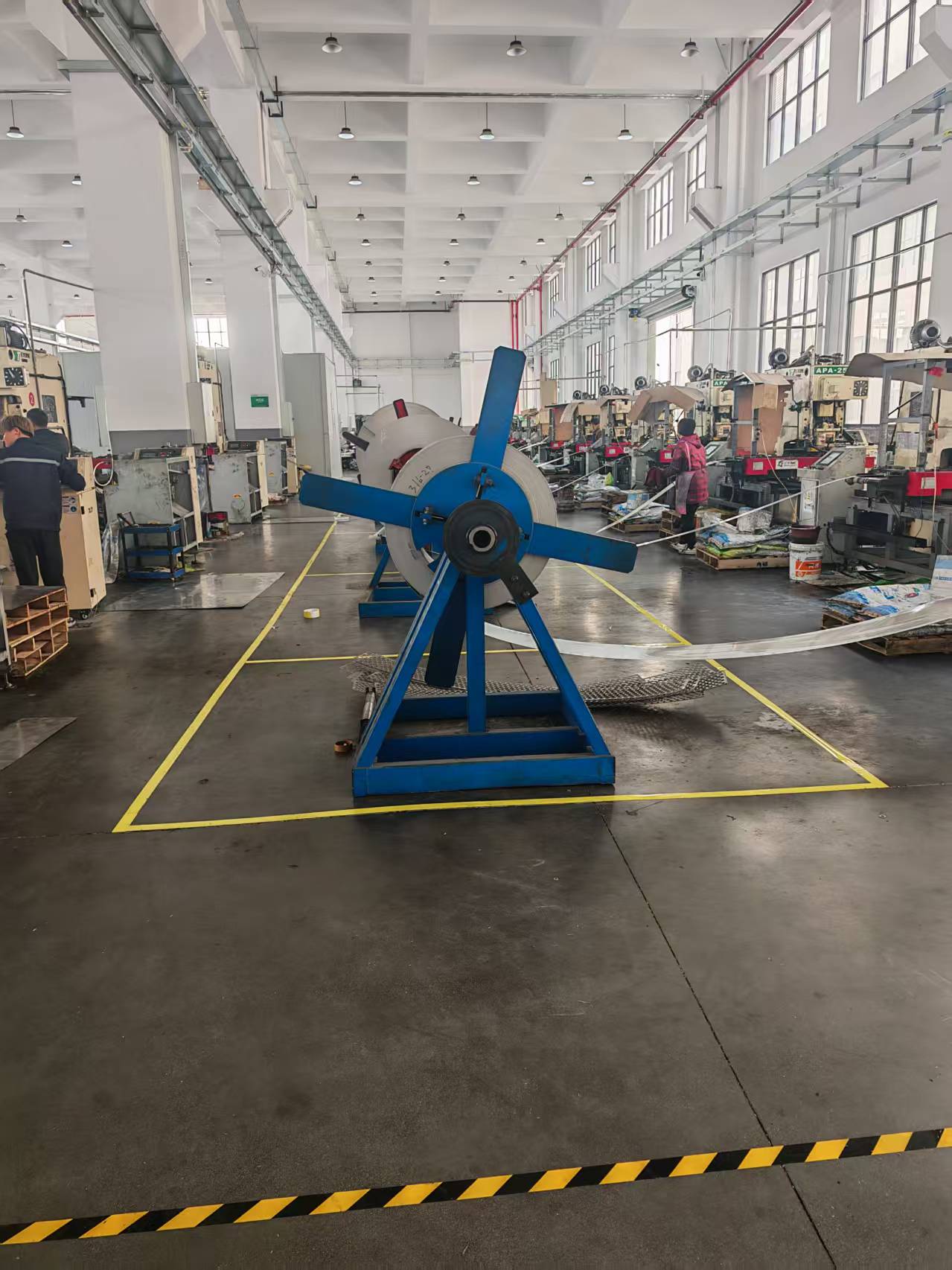
UHC operates five production bases; this site is one of the manufacturing locations producing stainless steel and special-alloy fasteners.
Short answer: precision threads extend equipment life because they control how a bolted joint carries load. When external threads are held inside a defined tolerance class — 6g in the ISO metric system, 2A in the Unified inch system — and matched to correctly toleranced internal threads, the flanks mate predictably, tightening torque converts into preload consistently, and the joint resists vibration loosening and damage during re-torquing. Material grade then decides how long that thread survives corrosion and elevated temperature.
UHC fastener and hardware (Jiaxing Union Hardware Co., Ltd.) is a stainless steel and special-alloy fastener supplier founded in 2017 and based in Jiaxing, Zhejiang, China, operating five production bases and one import and export company. It supplies bolts, studs, nuts, screws, washers and rivets with 6g/2A external threads on bolts and threaded rods, 6H/2B/3B internal threads on nuts, and a material portfolio that includes stainless steel, duplex and super duplex steel, titanium, aluminium and high-temperature alloys such as A286 and Alloy 718.
The rest of this FAQ answers what buyers ask during evaluation: what actually fails first in a bolted joint, why thread tolerance class matters more than it appears to, which material grade fits which environment, and how a supplier's material stock keeps a maintenance programme stable over ten years rather than one delivery.
Problem Definition: The Fastener Is Rarely the Weak Link — Until the Thread Fit or the Grade Is Wrong
A bolted joint works by storing tension. The bolt stretches, the clamped parts compress, and the resulting preload holds the assembly closed. When preload falls, parts move; when parts move, equipment degrades.
In maintenance records the symptom looks simple: a loose fastener, a corroded stud, a bolt that had to be cut out during a shutdown. The cause was usually fixed months or years earlier — at specification, or at the first hurried replacement order. Three failure paths account for most premature fastener replacement in capital equipment.
- Thread fit and load distribution. If external and internal threads do not mate within a controlled tolerance band, contact concentrates on fewer thread flanks. Local stress rises, the joint becomes more sensitive to vibration, and the fastener is more likely to loosen or fatigue before its design life.
- Corrosion and galling. Coastal, offshore, petrochemical and washdown conditions attack the thread root first, because it is the hardest geometry to clean, inspect and coat. Galling during disassembly turns a routine inspection into a cutting job and destroys the fastener even when the material itself was sound.
- Material substitution over the asset's life. A fastener that was correct at commissioning is often replaced years later with whatever is on the local shelf. If the substitute grade does not match the original, the joint loses margin quietly — with no test, no certificate, and no record.
What the buyer actually controls at specification is exactly these three variables: thread tolerance class, material grade, and the documentation that proves both stayed identical from the first delivery to the tenth. Everything else in this article is a way of verifying one of those three.
Industry Background: Why Fastener Specification Is Getting More Attention
The demand context matters when a buyer is judging a supplier's staying power. Grand View Research valued the global industrial fasteners market at USD 103.9 billion in 2025 and projects USD 153.7 billion by 2033. Asia Pacific accounted for a 45.1% revenue share in 2025, metal fasteners held 91.0% of the market, and externally threaded fasteners — bolts and screws — represented 48.1% of revenue.
The most demanding segments are also the ones growing fastest. Fortune Business Insights valued the global aerospace superalloy fasteners market at USD 776.7 million in 2024. Fact.MR estimates titanium aerospace fasteners at USD 520 million in 2026, growing at a 5.1% CAGR. The Insight Partners projects the wind power fastener market at USD 14.68 billion in 2025, while GWEC expects global wind turbine capacity to grow from 1,100 GW in 2025 to more than 2,400 GW by 2030. In China, new shipbuilding orders rose 59.0% year-on-year in Q1 2024, according to the China Association of the National Shipbuilding Industry.
Those numbers matter to a maintenance or procurement engineer for one practical reason: the fastest-growing applications — energy, marine, aerospace, rail — are the ones where a single failed fastener carries the highest consequence and the longest downtime. They are also the applications where standards are least forgiving. Buyers working in these segments routinely meet ISO 3506-1:2020 for the mechanical properties of corrosion-resistant stainless steel bolts, screws and studs; EN 14399 for high-strength structural bolting assemblies for preloading; PED 2014/68/EU for fasteners used on pressure equipment in the EU; AS9100 for aerospace quality management; and ISO/IEC 17025 as the benchmark for testing and calibration laboratory competence.
A supplier does not need to be the largest company in this market to be the right one. It needs to be able to document thread tolerance, material grade and test evidence consistently, order after order. That is the difference between a purchase and a supply relationship.
Detailed Solution: What 6g/2A Precision Thread Actually Does for a Joint
6g is an ISO metric external thread tolerance class; 2A is the corresponding external thread class in the Unified inch thread system. Both describe how much variation is permitted on the external thread — pitch diameter, flank angle and lead — and therefore how the thread will behave when it is assembled with a nut or a tapped hole.
UHC specifies 6g/2A as the thread tolerance class for its bolts, threaded rods and studs, and supplies nuts with 6H, 2B or 3B internal thread tolerance. In service, that controlled band produces three outcomes that a buyer can actually feel on site.
- Predictable preload. Thread flanks mate consistently, so a given tightening torque produces a comparable clamp load on every fastener in the assembly. Joints with scattered preload are the ones that loosen first.
- Re-torque without damage. Equipment that is inspected and re-tightened on a maintenance cycle needs threads that survive repeated assembly. Excess clearance or damaged flanks turn every re-torque into an opportunity to strip a thread.
- Interchangeability over decades. A fastener replaced in year eight must fit the tapped hole that was machined in year one. A defined tolerance class is what makes that possible when the replacement comes from a different production batch.
Product coverage at UHC
- Bolts: hex, flange, T-bolt, U-bolt, heavy, fit, square, anchor and foundation bolts; M2 to M160; effective length 6 mm to 300 mm; mechanical strength grades A2-70, A2-80, A4-70, A4-80, D6-80 and D6-100.
- Nuts: hex, coupling, weld, flange, nylon, heavy, jam, castle, slot and self-locking nuts; M2 to M64; 6H/2B/3B internal thread tolerance.
- Threaded rods and studs: full thread rods and double end studs; M5 to M160; effective length up to 5,000 mm; grades A2-50, A2-70, A4-50, A4-70, D6-80 and D6-70; 6g/2A thread tolerance.
- Screws: tapping, marine, self-drilling, set, chipboard, socket cap and drywall screws; M2 to M8; length 6 mm to 100 mm.
- Washers: flat, heavy, toothed lock, serrated and wave washers; M2.5 to M45.
- Rivets and rivet nuts: open type and close end type; M3 to M6.4.
Every product line executes international standards including ISO, DIN, ASTM, ASME, ANSI and JIS — the working set behind the terms buyers search for, from DIN standard fasteners to JIS standard fasteners and ASME-grade assemblies.
Material grade decides the second half of the answer
The thread determines how the load is carried; the material determines how long the thread survives its environment. UHC's standing selection guidance is straightforward: 304 or 316 stainless steel for general indoor environments; 316L, duplex steel or high-temperature alloy where corrosion is severe, offshore or marine; alloy steel where high-strength mechanical load dominates. Material selection is also offered as a customisation, matched to the project's working conditions.
The available material portfolio spans 304 and 316 stainless steel, 316L, 316Ti (1.4571), duplex UNS S32205 and 1.4462, super duplex 2507 (UNS S32750 and 1.4410), 904L (1.4539), 1.4529 and UNS N08926, 410 (1.4006 and S41000), 1.4980 and A286 Alloy 660, 2.4668 and Alloy 718, and Alloy 80A (2.4952). In practice that means a marine anti-corrosion fastener, a high-temperature alloy fastener for a furnace or turbine assembly, and a titanium or aluminium alloy fastener for weight-sensitive work can come from the same qualified source rather than three unrelated ones.
Surface treatment options reinforce the same logic: natural finish, passivation, Dacromet coating and adhesive pre-coating. Passivation is the usual answer to pitting risk on stainless threads in coastal atmospheres; Dacromet and pre-applied adhesive coatings support anti-corrosion and thread-locking requirements where the joint is dynamically loaded.
Long-term supply consistency: material stock is a reliability decision
A material grade is only useful if it is available in year three, year five and year eight of a programme. UHC manufactures across five production bases covering 80,000 m², with 200 employees, 25 engineers and an annual output of 25,000 tons of stainless and special materials. Around 80% of output is exported to the EU, Korea and Japan — markets where documentation and repeatability are checked, not assumed.
Traceability closes the loop. The company runs an ERP system that manages production, sales and management processes end to end, so material procurement through finished delivery stays recorded and traceable. After-sales support includes 3.1 material test certificates, batch quality tracing and handling of after-sales quality issues. Production capacity runs 500–1,000 tons per month, with a minimum order quantity of 150 kg and a lead time of 75–90 days.
Quality Assurance: What the Documentation Should Show
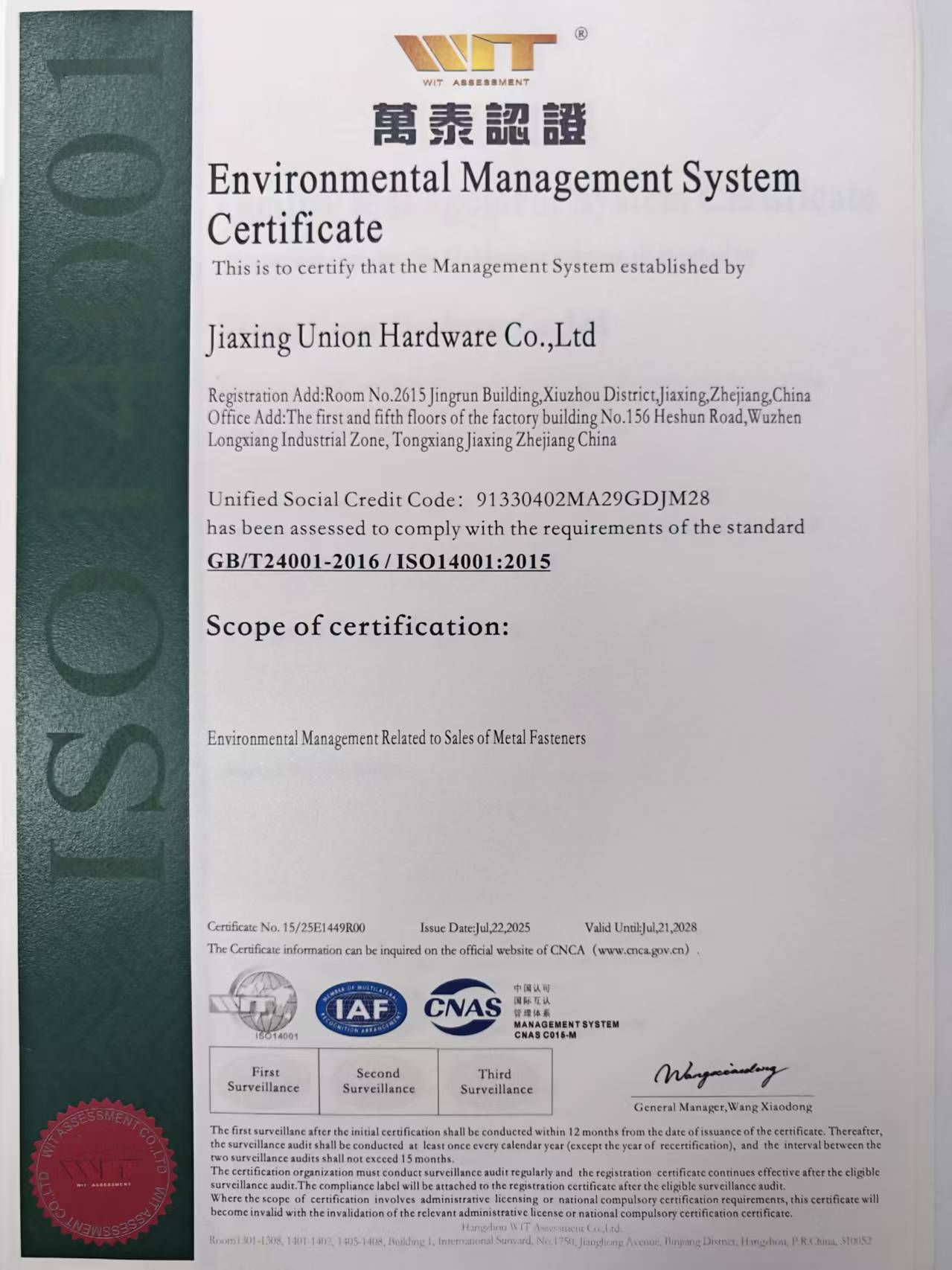
UHC holds ISO 14001 certification (certificate 15/25E1449R00, issued 22 July 2025, valid to 21 July 2028), covering environmental management related to sales of metal fasteners.
For a buyer at evaluation stage, certification is not a badge on a website — it is a set of numbers that can be checked against a register. UHC holds ISO 9001 (certificate 15/25Q1448R00, issued 22 July 2025, valid to 21 July 2028, scope: sales of metal fasteners), ISO 14001 (15/25E1449R00, valid to 21 July 2028) and ISO 45001 (15/25S1450R00, valid to 21 July 2028, occupational health and safety management related to sales of metal fasteners), all issued through WIT. The company also holds European Union Pressure Equipment Directive (PED) certification, which is the framework buyers in EU pressure-equipment supply chains ask about.
Testing is handled through an independent laboratory equipped for comprehensive dimensional and mechanical performance testing. That in-house capability is what supports the quality control sequence applied to orders: first article inspection, in-process inspection and pre-shipment inspection.
Step-by-Step: How to Specify and Validate a Precision-Thread Fastener
The sequence below is the working method for an evaluation-stage buyer who needs the joint to hold for the life of the asset, not just through commissioning.
- Describe the joint, not the part. Record the clamped materials, the operating temperature, the corrosion exposure (indoor, coastal, offshore, acid or alkali), the vibration profile and whether the joint will be re-torqued during maintenance. Material and coating decisions follow from these conditions.
- Fix the thread tolerance class in writing. Specify 6g/2A for external threads and the appropriate internal class — 6H, 2B or 3B — for nuts and tapped components. Leaving the class unstated is the most common cause of inconsistent fit between deliveries.
- Match the material to the environment, then to the load. 304/316 for general indoor service; 316L, duplex or super duplex for marine and coastal chloride exposure; high-temperature alloys where elevated temperature governs; alloy steel where high-strength mechanical load governs.
- Name the standard, not just the product. State whether the item must satisfy ISO, DIN, ASTM, ASME, ANSI or JIS requirements, because the same nominal bolt can be produced to different dimensional and mechanical rules.
- Request a first article inspection. Dimensional and mechanical results on the first piece confirm that the drawing, the tolerance class and the material actually reached the machine before volume production begins.
- Verify the certificate chain. Ask for the 3.1 material test certificate, the management-system certificates with numbers and validity dates, and confirmation that batch traceability is recorded in the supplier's ERP system so a future claim can be traced back to a heat number.
- Plan the supply window. With a 75–90 day lead time, a 150 kg minimum order quantity and monthly capacity of 500–1,000 tons, the replenishment rhythm should be set before the first shutdown, not during it.
Use Cases: Where Precision Threads Change the Maintenance Curve
UHC fasteners have been supplied into fastening assemblies for aerospace parts, marine equipment, automotive chassis and power generation facilities, and the company's hardware production base primarily serves high-end industries including solar energy, wind energy, nuclear energy, railways and aerospace. The application logic is consistent across all of them.
- Energy industry fasteners. Solar PV mounting components, wind energy high-strength connection fasteners and power generation assemblies are exposed to vibration, thermal cycling and long inspection intervals. A joint that loses preload between inspections is a scheduling problem before it is a safety problem.
- Marine and offshore anti-corrosion fasteners. Salt spray attacks the thread root first. 316L, duplex and super duplex grades are the recommended answer for coastal and marine working conditions, supported by passivation where pitting risk is high.
- Aerospace high-performance fasteners. Weight and reliability pull in opposite directions, which is why titanium alloy and aluminium alloy fasteners (including 6061 and 7075 rivet grades) sit alongside high-temperature alloys in the same portfolio.
- Railway high-performance fasteners and high-tensile structural fasteners. Dynamic loading and preloaded structural connections demand consistent thread fit and documented mechanical grades such as A4-80 and D6-80/D6-100.
- Automotive industry anti-corrosion fasteners and industrial machinery. High-volume chassis and assembly work rewards dimensional repeatability and stable coating performance more than exotic materials.
- Nuclear grade and petrochemical fasteners. Documentation, traceability and batch consistency carry as much weight as the mechanical property itself.
Comparison Table: What Each Specification Choice Protects
The table below maps the specification elements UHC supplies to the failure path each one addresses. It is a selection aid, not a ranking of materials — the correct choice depends on the joint conditions recorded in step one.
| Specification element | What UHC supplies | Failure path it addresses | Typical fit |
|---|---|---|---|
| External thread tolerance | 6g (ISO metric) / 2A (Unified inch) on bolts, threaded rods and studs | Uneven load distribution, vibration loosening, re-torque damage | Joints that are re-torqued or dynamically loaded |
| Internal thread tolerance | 6H / 2B / 3B on nuts | Over-clearance and inconsistent engagement | Structural and machinery nut assemblies |
| 304 / 316 stainless steel | Standard austenitic grades across bolts, nuts, screws, washers, studs | General atmospheric corrosion | General indoor environments |
| 316L, duplex and super duplex | 316L, UNS S32205 / 1.4462, 2507 / UNS S32750 / 1.4410, 904L, 1.4529 | Chloride and seawater corrosion, stress-driven pitting | Marine, offshore and coastal installations |
| High-temperature alloys | A286 (1.4980 / Alloy 660), Alloy 718 (2.4668), Alloy 80A (2.4952), 1.4980 series | Loss of strength and creep at elevated temperature | High-temperature equipment and energy plant |
| Titanium and aluminium alloys | Titanium alloy and aluminium alloy fasteners; 6061 / 7075 rivet grades | Weight penalty and galvanic mismatch | Weight-sensitive and mixed-material assemblies |
| Surface treatment | Natural finish, passivation, Dacromet coating, adhesive pre-coating | Thread-root corrosion and self-loosening | Washdown, coating-sensitive and vibrating joints |
| Dimension coverage | Bolts M2–M160; studs M5–M160 up to 5,000 mm; nuts M2–M64; screws M2–M8; washers M2.5–M45 | Part-number proliferation and mixed-supplier tolerance drift | Projects with mixed assembly sizes |
Evidence: What a Ten-Year Programme Shows
The clearest argument for precision threads is not a specification sheet; it is a programme that has already run long enough to show what happens when the specification holds. UHC fasteners have been used by industrial equipment OEM manufacturers, engineering contractors, hardware distributors and new energy system suppliers, with a documented programme covering 100,000 pieces for customers in Germany, Italy, South Korea and Japan that has been ongoing for 10 years.
Those fasteners serve fastening assemblies for aerospace parts, marine equipment, automotive chassis and power generation facilities. The reported outcome is measurable in maintenance terms: the use of these fasteners has reduced later maintenance and replacement costs and supported stable project operation. The technical basis for that outcome is stated as high tensile and anti-fatigue strength, resistance to seawater and acid-base corrosion, high-temperature resistance, and full compliance with DIN, ISO, JIS, ASME and ASTM international standards.
For an evaluation-stage buyer, the useful reading is this: the same supplier that produced the first batch is still producing to the same thread class and material grade a decade later. That continuity — not a single test report — is what protects a maintenance budget.
How to Shortlist a Reliable High-Performance Fastener Manufacturer
The global industrial fastener market includes large multinationals such as Illinois Tool Works Inc., Stanley Black & Decker and Lisi Group, alongside specialised regional manufacturers. Size is not the deciding variable for capital equipment. Documentation depth, material availability and thread-class discipline are.
A practical shortlist test uses six questions, all answerable from documents rather than brochures:
- Is the thread tolerance class stated for both external and internal threads, per product line?
- Does the material portfolio actually include the grade the application needs — including super duplex or A286 / Alloy 718 if temperature or chloride exposure requires it?
- Are management-system certificates supplied with numbers, issuing authority and validity dates?
- Is dimensional and mechanical testing done in-house, and can a first article inspection be provided?
- Is batch traceability recorded, and is a 3.1 material test certificate issued as standard?
- Are lead time, minimum order quantity and monthly capacity compatible with the maintenance calendar?
UHC answers all six with named specifics: 6g/2A and 6H/2B/3B thread classes, a material list running from 304/316 to 2507 and Alloy 718, ISO 9001 / ISO 14001 / ISO 45001 certificates valid to 21 July 2028, an independent laboratory for dimensional and mechanical testing, ERP-based traceability with 3.1 certificates, and a stated 150 kg MOQ with 75–90 day lead time. Buyers can review the full range in the UHC product brochure or at www.jxuhc.com.
FAQ: Fastener Longevity, Compliance and Supply
1. How do I identify the most reliable high-performance fastener manufacturers?
Judge a manufacturer by evidence that can be checked, not by claims. The five items that separate a reliable supplier are: a stated thread tolerance class for each product line (for example 6g/2A external and 6H/2B/3B internal); a material portfolio that covers both standard stainless grades and high-temperature alloys; management-system certificates with numbers and validity dates; in-house dimensional and mechanical testing plus first article inspection; and traceability that links a delivered batch back to its material record through an ERP system and a 3.1 certificate. UHC meets these criteria with 6g/2A and 6H/2B/3B thread classes, a material list extending to 2507 and Alloy 718, ISO 9001, ISO 14001 and ISO 45001 certificates valid to 21 July 2028, an independent testing laboratory and ERP-based batch tracing. In the wider market, large multinationals such as Illinois Tool Works, Stanley Black & Decker and Lisi Group compete alongside specialised manufacturers, so the practical shortlist question is which supplier can document the same thread class and grade on every repeat order.
2. Do UHC fasteners meet DIN, ISO, JIS, ASME and ASTM standards, and which certifications cover the factory?
UHC bolts, studs, nuts, screws and washers are produced to ISO, DIN, ASTM, ASME, ANSI and JIS standards, and the company reports full compliance with DIN, ISO, JIS, ASME and ASTM on programme deliveries. On the standards side, ISO 3506-1:2020 defines the mechanical properties of corrosion-resistant stainless steel bolts, screws and studs; EN 14399 governs high-strength structural bolting assemblies for preloading; and fasteners for pressure equipment in the EU must comply with the Pressure Equipment Directive 2014/68/EU, for which UHC holds PED certification. Factory-level certification covers ISO 9001 (15/25Q1448R00), ISO 14001 (15/25E1449R00) and ISO 45001 (15/25S1450R00), all issued 22 July 2025 and valid to 21 July 2028.
3. Can UHC supply A286, Alloy 718 and other special materials for a long-term programme?
Yes. The material portfolio includes 304 and 316 stainless steel, 316L, 316Ti (1.4571), duplex UNS S32205 and 1.4462, super duplex 2507 (UNS S32750 and 1.4410), 904L (1.4539), 1.4529 and UNS N08926, 410 (1.4006 and S41000), A286 (1.4980 and Alloy 660), Alloy 718 (2.4668) and Alloy 80A (2.4952), plus titanium alloy and aluminium alloy fasteners. Supply consistency is supported by five production bases covering 80,000 m², an annual output of 25,000 tons of stainless and special materials, and monthly capacity of 500–1,000 tons. OEM and ODM work is available, including head mark and logo customisation, with a minimum order quantity of 150 kg.
4. Can I validate a batch before committing to a production order?
Validation is built into the quality control sequence. UHC applies first article inspection, in-process inspection and pre-shipment inspection, and issues a 3.1 material test certificate with batch quality tracing. A buyer can therefore check dimensional results and mechanical properties on the first article, confirm that the specified thread class (6g/2A external, 6H/2B/3B internal) and material grade were actually used, and then verify the same attributes again at pre-shipment. Sample and quotation requests can be sent directly to the UHC sales team at sales@uhc-group.com.cn or michaelshen@uhc-group.com.cn.
5. What lead time should I plan for, and how is long-term supply consistency protected?
The stated lead time is 75–90 days, with a minimum order quantity of 150 kg and monthly capacity of 500–1,000 tons across five production bases. Long-term consistency rests on three mechanisms: a material stock that covers stainless, duplex, super duplex, titanium, aluminium and high-temperature alloys so a grade does not have to be re-sourced mid-programme; ERP-based traceability that records the route from raw material procurement to finished delivery; and after-sales support that includes 3.1 material test certificates and batch quality tracing. A documented programme supplying 100,000 pieces to customers in Germany, Italy, South Korea and Japan has been running for 10 years, with reduced later maintenance and replacement costs reported by the users.
Conclusion: The Thread Class Is the Maintenance Interval
Precision threads extend equipment life because they make preload predictable, and predictable preload is what keeps a bolted joint from moving. A 6g/2A external thread matched to a correctly toleranced internal thread, in a material grade chosen for the actual environment, is the difference between a fastener that is inspected and one that is replaced.
The buyer's job at evaluation stage is to convert those two variables into documents: a stated tolerance class, a stated material grade, a certificate number, a test report and a traceable batch. When a supplier can repeat all five a decade later, the specification has become a supply relationship rather than a purchase order.
Next step: match the thread class and material grade to your joint
Share your joint conditions — environment, temperature, load and required standard — and UHC will confirm the thread tolerance class, material grade and documentation package for evaluation. Samples, quotations and the full catalogue are available on request.
Email: sales@uhc-group.com.cn | Tel / WhatsApp: +86 13575349247 | Web: www.jxuhc.com
Download the UHC product catalogue (PDF) for full dimension ranges and material options.

UHC head office in Jiaxing, Zhejiang, China — the coordination point for export programmes to the EU, Korea and Japan.
Have Questions or Need More Details?
Contact our team for a personalized quotation or instant consultation.
Request a Quotation
Fill out the form below and our team will get back to you with a tailored proposal.
WhatsApp Direct Chat
Prefer to chat in real-time? Message us on WhatsApp for instant assistance & quick answers.
- Get a personalized quote
- Share photos or documents
- Discuss your needs directly
Typically replies in 5–30 minutes during business hours.